There is a comfortable assumption behind most conversations about why people buy counterfeits: they do it because they cannot afford the real thing. For part of the market that is true, and those buyers were never going to become customers anyway. For another part it is simply wrong, and that is the part worth caring about.
Some people buying a fake pair of headphones for $60 genuinely could not stretch to the official 180. For them there is no dilemma, only a shortcut to something otherwise out of reach. Others had the 180 in the bank and still chose the fake. Something stopped them from spending it, the shortcut was right there, and a sale the brand could have won quietly disappeared.
That second group is the one this piece is about. If the problem were pure affordability, the answer would be price. When someone who can afford the original still takes the fake, price is not the lever it looks like. A good-enough substitute sitting one click away is a different problem, and it needs a different answer.
So the question is who really buys counterfeits, why luxury and premium brands lose very different things when it happens, and what published research says about the moment a buyer who could pay decides to pay after all. That recoverable group has a name here: deflected demand.
A market bigger than brands assume
Before the psychology, the size. In its 2025 joint study, the OECD and the EU Intellectual Property Office measured a trade most brands underestimate.
One number in that report matters more than the headline. In 2020 and 2021, 79% of all counterfeit seizures were shipments of fewer than ten items, up from 61% a few years earlier. The trade has broken into small parcels. The fight has moved from the shipping container to the online listing, which is exactly where a brand can see it, and act on it.
But volume is only half the story. Knowing how much fake product exists says nothing about how much of it a brand could ever recover. Answering that means looking at who is buying, and why.
Luxury and premium are not the same thing
Put a fake Rolex and a fake pair of Nike running shoes side by side, and behind them are two very different buyers, even though both are holding a counterfeit. To see why, it helps to split what these products actually sell into two layers.
Materials, engineering, build, function. It can be measured, compared and, up to a point, felt.
- Premium is built on it.
- A fake can copy it well enough to clear the bar.
Exclusivity, belonging, the sense that not everyone can have this. It lives outside the object.
- Luxury is defined by it.
- A fake can never copy it. Exclusion cannot be faked.
Premium sits mostly on delivered value. A premium product should genuinely deliver more: it earns its price with real, measurable superiority, and then adds a layer of brand intangibles on top. But the foundation is that the thing is objectively better. Luxury has that delivered value too, often in even greater quantity, with exceptional materials and craftsmanship. But what defines luxury, though, is access. Its price guards that access. If everyone could reach it, it would stop being luxury, so exclusion is not a side effect, it is the product.
This is why the counterfeit behaves so differently in each case. In premium, the fake can imitate the layer that matters: copy the function well enough and it clears the bar, because the premium was built mostly on delivered value. In luxury, the fake can copy the logo and even the materials, but it can never copy access. Exclusivity is the one thing that does not live inside the object. So the luxury fake buys the symbol, never the belonging, because belonging is precisely what cannot be faked.
The consequence is sharp. In luxury, the fake competes with an aspiration the brand was never going to sell to that person anyway. In premium, it competes with a real sale the brand could have won.
Luxury is the most faked and the hardest to quantify
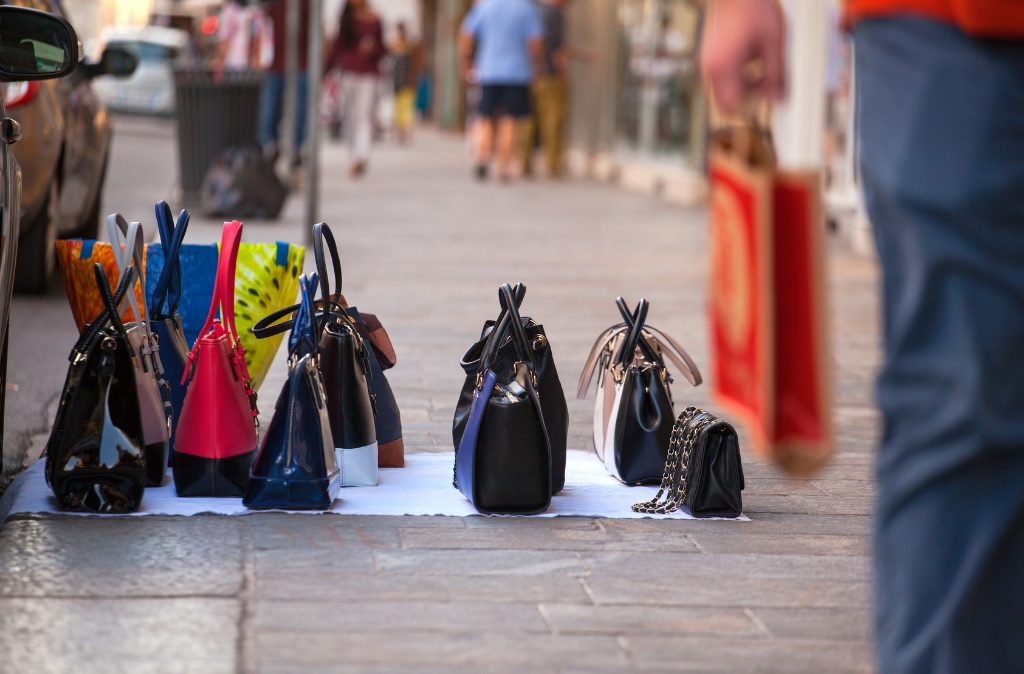
Follow that asymmetry through and it leads somewhere counterintuitive. Luxury is where the counterfeit problem looks largest. Watches, handbags and leather goods are among the most copied categories in the world, and a walk through any tourist market makes the scale obvious. So the reflex is that luxury must be losing the most. The numbers do not behave the way the reflex expects.
Start with who buys a luxury fake. That buyer is not weighing a genuine Rolex against a fake one and picking the cheaper. They were never in that comparison, because the real thing was out of reach on price and a genuine purchase was never on the table. What they are buying is the symbol, and they know exactly what they are buying. There is no substitution, no sale quietly redirected, because there was no sale to redirect. Research on the motive backs this up: Wilcox, Kim and Sen (2009), in the Journal of Marketing Research, found that demand for counterfeit luxury runs on a social signaling function, expressing an identity or fitting into a group, rather than on the value the product delivers. The fake and the genuine serve different goals, and one does not stand in for the other.
So if the lost sale is not the damage, where is it? Not in the fake buyer at all. It is in the genuine one. Luxury sells scarcity, but above all it sells exclusion, the quiet certainty that owning the thing places its owner on one side of a line and most people on the other. A convincing fake, sold widely enough, blurs that line. The brand starts to feel common, seen on too many arms, and the exclusion its real customers paid for begins to thin. The threat to the bottom line is not the counterfeit sale, but the genuine customer deciding the brand no longer says what they bought it to say.
The research on that reaction is more pointed than the dilution cliche. Commuri (2009), in the Journal of Marketing, found that owners of genuine items respond to their brand being counterfeited in one of three ways:
Flight is the one that reaches the P&L. In the same vein, Han, Nunes and Dreze (2010), also in the Journal of Marketing, showed that the wealthiest, most status-secure buyers gravitate toward quiet luxury, subtle goods only their peers recognize, precisely to separate themselves from the loud, heavily branded products that counterfeiters copy most. When the fakes get good and common, the real customer moves away from the very signals the fake relies on.
None of this means the effect is huge or automatic. It is worth holding the honest counterweight in view: Nia and Zaichkowsky (2000), in the Journal of Product and Brand Management, found that 70% of genuine luxury owners said the value, satisfaction and status of their brand were not reduced by the wide availability of counterfeits. Most owners, asked directly, shrug. The risk is real but concentrated, felt most by the exclusion-driven customers a luxury house can least afford to lose, and it moves slowly, as reputation rather than as a line on this quarter’s report.
That is why the damage resists a number, and why luxury houses spend so heavily fighting fakes that cost them almost no direct sales. They are not protecting a stack of lost transactions. They are protecting the exclusion that is the actual product. The measurable, recoverable problem, the one where a specific buyer wanted the brand and took a cheaper door into it, does not live here. It lives in premium. Everything that follows, and the calculator at the end, is about that.
Choosing the best option or settling: two ways of deciding
Why would someone settle for a fake when they could pay for the original? Because of how they decide in that moment, and here consumer research is unusually clear.
A 2022 study in the Journal of Business Research by Katyal, Dawra and Soni compared the mindsets behind luxury, premium and counterfeit choices. Buying luxury, they found, tends to trigger a maximizer mindset: the search for the single best option, with real discomfort at settling for anything less. Buying in the premium space tends to trigger a satisficer mindset instead: the person stops once they find an option that is genuinely good enough for what they need, and they are at ease with a choice that is not theoretically perfect.
The key is that these are not two kinds of person. The same buyer maximizes in one category, buys mid-range in another and goes low cost in a third, depending on how much the product matters to them at that moment. What changes is not the shopper, it is the decision mode the purchase switches on.
And that is what makes the next part counterintuitive. In satisficer mode, the buyer is not running a careful comparison to find the best value. They found something that did the job, the search ended, and the choice felt reasonable. The fake did not win an argument against the original. It got there first and cleared the bar of good enough.
Passing on premium is not always a lost sale
It is tempting to treat every buyer who does not pay full price as demand lost to fakes. That is far too broad, and it leads brands to chase people who were never theirs to lose. Among those who can afford a premium product and still walk away, there are several different reasons, and only one of them ends at a counterfeit.
| Buyer who can pay but skips premium | Where they go instead | Recoverable? |
|---|---|---|
| The price-to-value equation does not close: the extra they pay is not matched by the extra they get | A lower-value product that still delivers what they need | Rarely, and only with an occasional discount that rebalances the equation |
| The value is there, but they would rather spend the difference elsewhere | A lower-value product that still delivers what they need | Not through price, it is a share-of-wallet choice |
| Wants this exact brand and its delivered value, but on the cheap | The counterfeit | Yes, this is the one that matters |
The first two rows are not really counterfeit buyers, and the reason is the same equation every purchase runs: price against perceived value delivered. For row one, the premium simply does not clear it: the extra cost is not matched by extra value they can feel, so a lower-value product that meets the need is the rational choice, not a compromise. For row two the value is there and recognized, but the buyer would rather put that difference toward something they value more. In both cases the need is met by a legitimate cheaper option, and the brand never really entered the fight.
The third row is different, and it is the whole game. This buyer is not solving a need with whatever fits. They want that specific brand and the value it delivers, logo, design, the thing itself, and the fake is simply the cheapest door into it. They have already done the hardest part of any sale, deciding they want what the brand makes. The only thing between them and a real purchase is a shortcut that is easier than the official one. That is deflected demand, and unlike the others, it is genuinely recoverable.
This is why a discount does not bring them back
Here is where most brands reach for the wrong lever. They see sales leaking to fakes, assume the issue is price, and cut it. The logic feels sound and the result is disappointing, and consumer research explains why.
A study by Yoo and Lee at Hofstra University asked a simple question: do counterfeits actually hurt the genuine product, or can they promote it? Across several luxury fashion categories, they found that people clearly prefer the real thing, until the price is shown. Once the price of the original is on the table, that preference collapses to the point where it is no longer meaningfully different from the preference for the fake.
Read that carefully, because it is the whole point. If simply seeing the price is enough to erase the advantage of the original, a discount does not fix the problem. It only narrows the gap the buyer is already comparing. The comparison itself is the damage, and a lower price does not make it disappear. It is worth adding that this study is two decades old and looked only at luxury, with a student sample, so it points at a mechanism rather than proving a number. But the mechanism holds.
Luxury makes the trap obvious. A luxury brand cannot discount at all, because a markdown would destroy the exact thing it sells, which is access. Burberry once burned unsold stock rather than mark it down, and that was not waste, it was logic. In luxury there is only one lever that touches perceived price, and it is not price. It is how hard the shortcut is to reach.
Premium plays by different rules
Luxury is the clean case because it has no price lever at all. Premium is messier, and more interesting, because it has three: it can discount, it can raise the cost of reaching the fake, or it can do both. Most brands only ever try the first one, and that is the mistake worth unpacking.
Think about who a premium discount actually reaches. It lowers the barrier for the buyer who was already close, the one hesitating over the price difference. Drop the price and some of them come in, pulled by the offer for that one purchase. That is a real gain, but a narrow one. It does nothing to the shortcut itself. The fake is still there, still one click away, still cheaper. The buyer who had already decided to take that route sees no reason to change.
So the two levers are not even competing for the same person. The discount captures the shopper who wavered on price. Raising the cost of the shortcut captures the shopper who had already left for it. Different buyers, different problems, and only one of them is the buyer a brand is actually losing to counterfeits.
It pays margin on customers it was going to keep anyway, and recovers none of the ones walking out the door.
That is the uncomfortable conclusion for any premium brand that answers fakes by cutting price. There is no published study that measures this split in premium specifically, so I am putting it forward as a reasoned hypothesis rather than a proven fact. But it follows directly from how the satisficer decides: someone who never ran the comparison in the first place has nothing for a modest discount to grab onto.
Making access to the fake harder
If price is the wrong lever, what is the right one? Go back to how the fake won in the first place. It did not win on price alone. It won because it was there, easy, one click away, good enough. The shortcut was frictionless. Change that, and the only variable that was actually keeping the sale away from the brand changes with it.
This is what brand protection does, stripped of the jargon. It does not chase counterfeiters for sport. It raises the cost of reaching the shortcut: takes down the listing, removes the rogue ad, breaks the easy path from wanting the product to buying a fake of it. When the shortcut stops being effortless, the buyer who wanted the brand no longer has the easy option, and now has to choose among three:
- pay for the original
- settle for a cheaper legitimate alternative that covers the need
- or buy nothing at all.
Only the first of those is a win for the brand.
How many? Nobody can say exactly, and anyone who names a precise figure is selling something. But there is a published ceiling. In a 2025 survey of two thousand US counterfeit buyers, Red Points found that 38% of deliberate fake buyers said they would stop buying counterfeits if there were simply fewer of them available online. Worth noting who published it: Red Points sells takedowns, so a number that flatters takedowns deserves a raised eyebrow. Still, the direction is clear and the sample is large.
Treat that 38% as a ceiling. Faced with no shortcut, some of those buyers pay for the original and come back. Others drop down to a cheaper legitimate product, and others simply walk away and buy nothing. Only the first group is recovered revenue, which is why the real recovery rate sits well below that ceiling, somewhere between zero and 38%. It is the single number this whole decision turns on, and the one no vendor will put in writing.
The customer who does not come back
So far the whole discussion has been about a sale that did not happen. There is a second cost, quieter and more expensive, and it shows up when the fake is bought by accident.
Remember that not everyone who ends up with a counterfeit went looking for one. In the same Red Points survey, a large share of fake purchases were unintentional: the buyer believed they were getting the real thing, on a marketplace or through an ad, and only found out afterward.
This accidental buyer is far more common in premium than in luxury, and the reason is the price gap itself. In luxury the discount is so extreme that it gives the fake away; almost nobody pays a fraction of the real price and expects the genuine article. In premium the gap is moderate, a believable discount rather than a red flag, so the buyer leans on other signals instead, the seller’s apparent legitimacy, the look of the listing, the reviews. That is where a convincing fake slips through as the real thing.
And here is the damaging part. When that happens, the buyer blames the brand, not the counterfeiter. In the same survey, a significant share of people who unknowingly bought a fake said they stopped buying from the genuine brand afterward. This is not deflected demand, a sale postponed. It is demand destroyed, a customer who walked out over a product the brand never made, and who may tell others why. And that customer is worth far more than a single sale: their customer lifetime value, every purchase they would have made over the relationship and now will not.
This second cost almost never appears in a brand protection pitch, because it is harder to sell than a recovered sale. A vendor can promise the revenue a brand might win back. Nobody wants to open with the revenue it is quietly losing.
For any brand doing the math honestly, the counterfeit problem has two lines, not one: the sale that could be recovered, and the customer that could be lost.
Quantifying deflected demand
Everything so far has been about behavior. Now the behavior has to become a number, because a brand does not defend a budget with psychology. It defends it with a figure a finance director can argue with.
Start with what a brand actually knows. Not the OECD’s global trade estimate, which measures customs seizures across whole economies and says nothing about one brand’s exposure online. What a brand knows is narrower and more useful: how many fake listings or infringements it detects, what its own product sells for, and how far below that the fakes are priced. Those are real inputs, not borrowed averages.
From there, deflected demand is simple to frame. Take the buyers who wanted the brand and took the shortcut, apply a recovery rate for how many would pay full price once the shortcut is gone, and the revenue is potentially back on the table. The catch is that recovery rate. As we saw, the published ceiling is 38%, the floor is zero, and the honest answer lives somewhere in between, unmeasured and unpublished.
So the useful question is not “how much will I recover”, which no one can answer. It is the reverse: “how much recovery does this need to be worth it?” If a brand protection service costs a certain amount per year, there is a break-even recovery rate above which it pays for itself and below which it does not. That number a brand can reason about. It can look at its own category, its own buyers, its own price gap, and decide whether clearing that bar is plausible. That is a decision, not a leap of faith.
The calculator below does exactly that. It does not tell a brand what it will recover. It tells it the recovery rate the investment has to beat, and lets it see how the answer moves as the inputs change.
Deflected Demand Calculator
Find the recovery rate a brand protection investment has to beat to pay for itself.
How many fake units you detect per year. If your monitoring tool reports listings or ads, estimate the units they represent. This is a figure your brand can measure, not an estimate of the market.
What the service costs per year. If you are still comparing quotes, use the one on the table.
The limits of the calculation
A calculator is only as honest as the assumptions under it, so it is worth being clear about what this one does not know. It does not know how many of the buyers behind those detected fakes actually wanted the brand, rather than a cheap alternative that happened to carry its name. It does not know how many, faced with no shortcut, would pay full price instead of walking away. Nobody knows those numbers, because they have never been measured at the level of a single brand.
That is why the tool gives a break-even, not a forecast. The 38% ceiling is real but borrowed, drawn from a survey run by a company that sells the very service in question, and it describes intent, not behavior. The floor is zero. The true recovery rate lives somewhere in that band, and no vendor, however confident the pitch, can hand it over in writing. Anyone who quotes a precise figure is selling, not measuring.
So the point of the exercise is not to predict a return. It is to reframe the decision. Instead of asking how much a brand might recover, which is unanswerable, it asks how little it would need to recover for the spend to make sense. That is a bar a marketing lead can weigh against their own category, their own price gap, their own buyers, and defend in a room where someone will ask for the math.
Counterfeits will not disappear, and no brand recovers all the demand they divert. But the reflex to answer them with a discount misreads the buyer entirely. The person taking the shortcut was not lost on price. They were lost on friction, and friction is the one thing a brand can actually change. Deflected demand is not a loss to accept but a number to work out, and then to argue for.
Note on sources. Global counterfeit trade figures are from the OECD and EU Intellectual Property Office joint study “Mapping Global Trade in Fakes 2025”, using 2021 customs data. Buyer behavior figures, including the 38% ceiling and the share of accidental purchases, are from “The Counterfeit Buyer Teardown” (Red Points and OnePoll, 2025); Red Points sells brand protection services, so figures that favor takedowns should be read with that in mind. The maximizer and satisficer distinction is from Katyal, Dawra and Soni, Journal of Business Research, 2022. The finding that price information erases the preference for the genuine item is from Yoo and Lee, Hofstra University, based on a luxury student sample. On luxury specifically: the finding that counterfeit luxury demand is driven by social signaling rather than product value is from Wilcox, Kim and Sen, Journal of Marketing Research, 2009; the flight, reclamation and abranding responses of genuine owners are from Commuri, Journal of Marketing, 2009; the retreat toward quiet, inconspicuous luxury is from Han, Nunes and Dreze, Journal of Marketing, 2010; and the finding that most genuine owners do not report feeling their brand devalued by counterfeits is from Nia and Zaichkowsky, Journal of Product and Brand Management, 2000. The premium discount hypothesis is the author’s own reasoning and is labeled as such in the text.
©2026 Oriol Guitart. All rights reserved, for the duration and extent established by the applicable intellectual property law. Any reproduction, distribution, public communication and/or transformation, in whole or in part, is strictly prohibited without the author’s express written authorization, and the author must in any case be credited as such in any subsequent use.