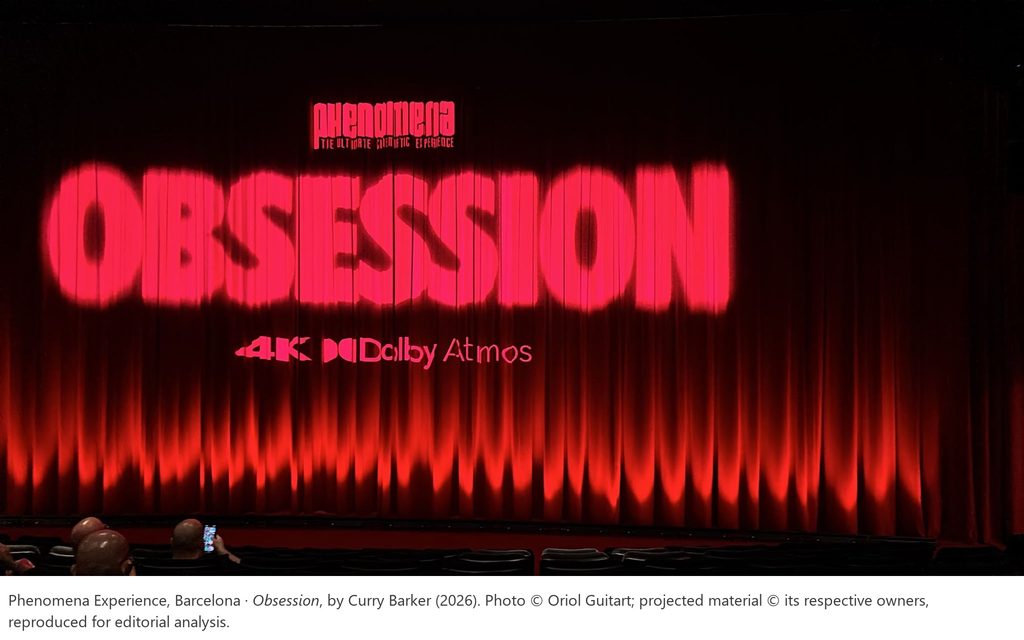
On September 5, 2025, at the Hotel Excelsior on the Venice Lido, a cinema from Barcelona received the Carlo Lizzani award for the best theater in Europe, which the Italian association of film authors presents every year during the Mostra. It was collected by Nacho Cerdà, founder and director of Phenomena Experience: a single screen on Carrer Sant Antoni Maria Claret, with 449 seats before its latest renovation and a staff of seven.
Between 2004 and 2025, Spanish theaters lost half of their audience, from 143 to 66.9 million, and a third of their box office. The question that contrast raises is how a venue becomes the best in Europe from inside an industry that has been shrinking for twenty years, with a single screen, devoting a large share of its program to films the audience has already seen, and charging new-release prices for many of them. The answer lies in the Phenomena Experience strategy.
What is the Phenomena Experience strategy?
Phenomena Experience competes with a strategy of focused differentiation: a single large-format screen, programming built on its own criteria, and screenings with unreserved seating. Its advantage holds for two separate reasons. One is physical: the chains carved their venues into multiplexes decades ago, and that construction cannot be undone. The other is credibility: programming this way demands a recognized cinephile standard, and a chain whose results depend on the distributors’ release calendar will find that very hard to build.
The three levels of strategy
Every strategy is decided at three heights. Each one answers a different question and follows from the one above it.
-
Level 1 · Corporate strategy
What business are we in?
Phenomena is not in the business of “showing movies.” It is in the business of producing a shared event around a screening. Two decisions follow from that definition: a single location, with no geographic expansion, and a second business of corporate events built on the same premises.
-
Level 2 · Business strategy
How do we compete in that business?
It differentiates on two things that do not depend on the film: how it is projected, and the criteria behind what gets projected. It accepts a smaller audience and a higher price in exchange for a screening that resembles no other theater’s. In an industry where the film is identical in every venue in the country, differentiation is only possible in what surrounds it.
-
Level 3 · Functional strategy
What gets decided every day to sustain it?
The ticket costs the same for a classic as for a new release, screenings are sold without assigned seats, the membership club only pays off for people who come often, and the program advances through director retrospectives and surprise screenings.
The result
And how long does that advantage last?
The VRIO analysis separates what Phenomena can defend from what it cannot. A chain is unlikely to tear down a multiplex to go back to a single screen, although it could buy or build one, and hire someone to program with judgment. What it cannot buy is having arrived first: its venue would be born as a version of something that already exists, and in a business that sells judgment and belonging, being the copy is a poor starting point. Programming is imitable, and the chains are already imitating it.
Industry data: ICAA (Spanish Ministry of Culture) and AIMC Cinema Census. Author’s own analysis.
What is the Phenomena Experience strategy?
Phenomena Experience competes with a strategy of focused differentiation: a single large-format screen, programming built on its own criteria, and screenings with unreserved seating. Its advantage holds for two separate reasons. One is physical: the chains carved their venues into multiplexes decades ago, and that construction cannot be undone. The other is credibility: programming this way demands a recognized cinephile standard, and a chain whose results depend on the distributors’ release calendar will find that very hard to build.
On March 28 and 29, 2026, before reopening to the public, Phenomena premiered the renovated venue with two screenings at 100 euros a ticket, without saying which film it would show. I bought one and attended the first of the two days. On Saturday they screened Kill Bill: The Whole Bloody Affair, 281 minutes with an intermission where catering was served. At the door they handed out popcorn and a soft drink, and a welcome pack with a commemorative gift (a phone stand shaped like the facehugger from Alien). The ticket also included Club Phenomena membership through December 31, 2026. Only 100 tickets were put on sale for each day and both screenings sold out.
There is one telling detail about that purchase: almost none of the above was stated at the point of sale. The 100-euro ticket did not announce the catering, the gift, or membership through December. Those of us who bought it knew the date, the price, and little else. General admission to the theater costs 12 euros. What was sold on those two days was an event of which only the date was known. The venue closed in September 2025 for renovation and reopened to the public on April 2, 2026, seven months after collecting the award in Venice.
Much has been written about Phenomena as a cultural phenomenon. This analysis is about something else: identifying its strategy with the models used in any business school, and answering one concrete question. Spanish exhibition chains run hundreds of screens, against Phenomena’s single screen and seven people.
If the model works, why doesn’t anyone copy it?
The industry: more seats than it needs
Spanish film exhibition has been losing audience for twenty years. The peak came in 2004, with 143 million admissions and more than 690 million euros at the box office. By 2019, before the pandemic, the figure was down to 104.9 million. In 2025 it stood at 66.9 million, with 460.3 million euros in box office. The cumulative drop is 53% since 2004 and 36% since 2019 alone. Supply did not follow the same path.
The number of screens barely moved: 3,695 in 2019 and 3,562 in 2025, 4% fewer. Capacity did fall, although far less than the audience. According to the AIMC Cinema Census, Spain had 732,080 seats in 2025, 66,172 fewer than ten years earlier, a drop of 8.3%. Over the same decade, admissions fell 30%. The following census, with data from May 2026, confirms the trend: 3,516 screens and 712,260 seats.
An industry that loses 30% of its demand and retires 8% of its capacity builds up overcapacity. And that shows in the key metric of this business, turnover: every seat in Spain was filled 120 times a year in 2015 and 91 times in 2025.
The industry’s reaction to that situation is documented in AIMC’s own census, which titles its 2025 edition “More cinemas, same screens, fewer seats” and describes it this way: “cinemas tend to operate with fewer screens, and with fewer seats in each screen, though larger and more comfortable.” The same report adds that “there are venues where part of the traditional seating has been replaced outright by beds.”
The Spanish average today is 206 seats per screen and 4.7 screens per cinema, with 970 seats per site, against 1,203 in 2014. Spain has 73 screens per million inhabitants and ranks seventh among eighteen Western European countries, ahead of the United Kingdom, Italy and Germany. The problem of Spanish exhibition has never been a shortage of screens.
The industry in four figures
Sources: Film Statistics of the ICAA (Spanish Ministry of Culture) and the 27th edition of the AIMC Cinema Census. Turnover per seat crosses the two sources, which use different perimeters, and is offered as indicative.
The decline has not been uniform. Between 2004 and 2013 the audience fell every year but one, from 143.9 to 78.7 million, the worst figure in the entire pre-pandemic series. The industry attributed that floor to the VAT increase on tickets from 8% to 21%, approved in September 2012, and the chronology appears to back it: 2013 was the first full year under the new rate.
Then came a partial recovery, in which the industry won back 26 million admissions in six years and returned to 104.9 million in 2019, with VAT down to 10% again from July 2018. The pandemic erased that trend in a single year: 27 million in 2020. Only part of the audience has returned since, and in 2024 and 2025 the figure has fallen again.
Cinema admissions in Spain
Source: Spanish Ministry of Culture. Admissions for all films exhibited. The years 2004 to 2014 come from the ICAA film market evolution table, and 2015 to 2025 from the Yearbook of Cultural Statistics and the Film Statistics. The two series agree in the years where they overlap.
Reading the numbers
Anyone programming a venue in Spain does so on top of demand that has not come close to its highs in twenty years, and with a stock of seats that has barely adjusted to it. That is the starting condition for any cinema in the country, Phenomena included.
How much margin is there in showing films?
Phenomena operates in an industry that has been losing audience for twenty years. Its decisions make more sense once another question is answered first: how much can be earned in that industry doing things the way every other theater does them? A cinema can be impeccably run and still earn little, because much of its bottom line is decided by other people.
That is exactly the question the five forces model answers, set out by Michael Porter in 1979. Its premise was disruptive at the time: how profitable a company is depends on how well it is run, and also on the structure of the industry it operates in, and that structure can, and should, be described precisely.
The model starts from a simple idea: the companies in an industry keep only part of the value it creates. Another part goes to whoever sells to them, which is the bargaining power of suppliers. Another stays with the customer who manages to pay less, which is the bargaining power of buyers. Another vanishes when there are alternatives that solve the same thing a different way, which is the threat of substitutes. And another is diluted when entering the business is easy, the threat of new entrants, because there are no strong barriers to entry. Those four feed the fifth, the rivalry among the companies already inside, and that is why it sits at the center of the diagram: the harder they squeeze, the less margin is left and the more competition comes down to taking customers from one another.
This model is not built to analyze the company. It describes the industry the company works in. What comes out of it are the conditions any cinema operates under, Phenomena included, and knowing them is what makes it possible to decide where to stand against the rest. In Spanish film exhibition, three of those five take a large share of the value and leave the exhibitor with little margin.
The supplier's bargaining power is very high. The supplier is the distributor, which holds the exhibition rights in the territory and signs the agreement with the cinema. The producer sits one step further back and does not negotiate with theaters, unless both are the same company, which is exactly what happens with the major studios, which produce and distribute at the same time. What the distributor charges appears on no public rate card: it is negotiated film by film as a percentage of box office, higher in the first week and declining afterward in five-point brackets.
In 2006 the Tribunal de Defensa de la Competencia, Spain's competition tribunal at the time, ruled on a complaint filed by the exhibitors' association against the five major distributors. During 2002, all five charged 60% of first-week box office on every one of their most commercial films. In a sample of twenty of those releases, spread across 446 cinemas, that ceiling was applied in almost all of them. Even one of the highest-grossing cinemas in the country, with real bargaining power, paid it on nine out of every ten releases. The tribunal concluded that a coincidence like that could not be accidental.
The distributor is the largest item deducted from every ticket, and it is not the only one.
Film exhibition data
How the €6.97 of a cinema ticket get split
Average price in Spain in 2025, from dividing 453 million euros of box office by 65 million admissions. It is an average with discounts baked in, well below the counter price on an ordinary day, which runs around €9.
Point in the run
Out of every €6.97, the exhibitor keeps €2.66€3.30€3.93 On opening weekend, when the house fills up, is when it keeps the least: the distributor takes exactly half of the ticket.A little under half of the ticket, and out of that come rent, staff, energy and the projection equipment.Its best split arrives weeks after the premiere, when there is hardly any audience left in the room.
- Exhibitor 38.2%47.3%56.4% €2.66€3.30€3.93 The venue. Net of VAT, and it pays for the premises, the staff and the equipment
- Distributor and producer 50.0%40.9%31.8% €3.49€2.85€2.22 A negotiated percentage, higher in the first weeks
- VAT 9.1% €0.63 Reduced rate of 10% on the taxable base
- Copyright royalties 2.7% €0.19 Collecting societies, on net box office
See the three scenarios in a table
| Destination | Opening | Full-run average | Week 5 |
|---|---|---|---|
| Exhibitor | €2.66 · 38.2% | €3.30 · 47.3% | €3.93 · 56.4% |
| Distributor and producer | €3.49 · 50.0% | €2.85 · 40.9% | €2.22 · 31.8% |
| VAT | €0.63 · 9.1% | €0.63 · 9.1% | €0.63 · 9.1% |
| Copyright royalties | €0.19 · 2.7% | €0.19 · 2.7% | €0.19 · 2.7% |
| Total | €6.97 · 100% | €6.97 · 100% | €6.97 · 100% |
The VAT figure is exact: a 10% rate on the taxable base equals 9.1% of the final price, so what the exhibitor and the distributor divide is already net of VAT. That split is not public, it is negotiated film by film, and Spain's competition tribunal documented that it is set as a percentage of box office, higher in the first weeks and then stepping down in five-point brackets. The three points in the run above reconstruct that mechanism with industry reference percentages, and they are not official figures. The average ticket comes from the 2025 box office and admissions data published by FECE, sourced from Comscore. Comscore and the Ministry of Culture do not measure exactly the same perimeter of venues, which is why the historical series closes 2025 at 66.9 million admissions while this panel works with 65.
What shapes the running of a theater most is the timing of that percentage. Opening week is what fills the cinema, and it is also when the exhibitor's split is at its worst. By the time the split improves, weeks later, the house has started to empty.
Phenomena is less exposed to that calendar, because it almost never bets on a long run. Its program turns over constantly: on November 29, 2026 it combined a recent release, T2 Trainspotting, Christopher Nolan's The Odyssey and The Rocky Horror Picture Show at half past eleven at night. It only extends a new release when there is a reason, and one of those reasons is usually that nobody else can offer it the same way. The Odyssey was still on the schedule that day, more than four months after its premiere, because Phenomena is the only cinema in Barcelona showing it in 70 millimeter.
The threat of substitutes is at its maximum. Streaming has multiplied what is available at home and has shortened the window between the theatrical release and the living room.
Buyer power, by contrast, is low. The moviegoer does not negotiate: they pay the ticket price or stay home. What usually gets mistaken for bargaining power is three different things:
- The weekly discount day, a fixture in Spanish cinemas, is occupancy management, the same kind hotels and airlines practice: an empty seat on Wednesday is worth nothing, and selling it cheap always beats not selling it.
- The "Fiesta del Cine" is a national promotion the industry itself runs twice a year, with tickets at €3.50.
- The €2 Cine Sénior tickets are public policy: they are subsidized by the Ministry of Culture, which allocated 11.5 million euros to participating venues in the 2026-2027 edition. Discriminating on price by day of the week or by age is only available to whoever sets the price.
Pressure on price does exist, and it enters the model through two other doors: the moviegoer leaves for substitutes when it stops being worth it, and theaters take customers from one another because they offer exactly the same film.
The five forces applied to film exhibition in Spain
Threat of new entrants
The investment in a venue and equipment is high, although there are no meaningful regulatory or technological barriers. The real barrier is demand, not entry.
Bargaining power of the distributor
It takes around 45% of net box office, with a percentage that rises on safe bets. The exhibitor accepts the rate if it wants the release.
Rivalry among competitors
Very high
Every theater opens the same film on the same day, so competition comes down to showtimes, proximity and price.
Bargaining power of the moviegoer
The moviegoer does not negotiate: they pay the published rate or stay home. The weekly discount day, the Fiesta del Cine and the €2 Cine Sénior tickets are all decided by the seller.
Threat of substitutes
Streaming, release windows that keep getting shorter, and a home offering that never stops growing.
Reading the numbers
Three forces squeeze at once: the distributor sets the split of the box office, substitutes have multiplied the ways to watch a film, and rivalry gets worse because the product is identical in every theater. The customer negotiates nothing, and the price paid still ends up below the published rate. An industry like this leaves little margin for anyone competing on volume and rewards anyone who steps outside the comparison. That is where Phenomena sits.
The product is identical across every competitor
In almost any industry, differentiation starts with the product. In film exhibition that is not available, because the product arrives finished from outside and is exactly the same everywhere. The same film, with the same running time and the same ending, at Cinesa, at Yelmo, at Ocine and at a small-town cinema.
Two consequences follow from that constraint, and they explain how the industry has behaved for thirty years.
- The first is that, if the product cannot be differentiated, competition shifts to price. Hence the permanent promotions and the erosion of the perceived value of a ticket.
- The second is that the only differentiation available sits in everything around the film: the screen, the sound, the seat, the parking, the shopping mall, the popcorn. The multiplex is the industrial answer to that second consequence, and for decades it looked like the right answer. More screens in one building spread the fixed cost of the property across more showings, cover several audiences at once, and turn the lineup over quickly.
What the multiplex does not solve is what to do when demand halves. A 206-seat auditorium with 40 people inside does not deliver a memorable experience, and the moviegoer who paid the same for screen 8 as for screen 1 notices the difference.
What the chains in Spain have tried
They have gone at it along several routes, and none of them involves changing what gets shown.
- They have cut the price. The weekly discount day, the Fiesta del Cine and Cine Sénior are volume instruments that compete against the perceived value of the ticket itself.
- They have tried the original version. In January 2020 Cinesa launched Cinesa VOSE, its subtitled original-language format: ten of its cinemas moved to several screens dedicated exclusively to subtitled originals, and another ten kept those screenings in a fixed slot, Tuesday evenings and weekend mornings. Back in 2015 it had already converted ten of the twenty screens at Cinesa Manoteras, in Madrid. My read, as someone who watches films in their original version, is that the fixed slot has a problem at its root: anyone who cares about the original version cares every day of the week, not only on Tuesdays. It is a permanent preference.
The difference with Phenomena is not one of size. For a chain, the original version is an option that coexists with the dubbed one, one more segment inside the same product. At Phenomena there is no dubbed version: it programs subtitled originals as a matter of course. Anyone who wants to watch the film dubbed is not its audience.
And others have bet on comfort. The clearest and most recent case is Grup Balañá, which created the Mooby brand for its cinemas in 2023 and on May 21, 2026 opened the Mooby Gran Sarrià Club: the eight screens of the complex converted to a boutique format, with a maximum of 88 seats each, motorized reclining seats and a gourmet bar.
That decision and Phenomena's were taken in the same market, in the same year and against the same diagnosis, and they run in opposite directions.
Two answers to the same diagnosis
Both renovations open in 2026, in Barcelona, facing the same decline in audience. They lay out almost the same capacity, 428 seats and 449, and they do it in opposite ways.
| Decision | Mooby Gran Sarrià Club | Phenomena Experience |
|---|---|---|
| Capacity | From 27 to 88 seats per screen, 428 in total | 449 seats in one auditorium |
| Number of screens | Eight | One |
| What it upgrades | Individual comfort: motorized reclining seats and a gourmet bar | The projection: a 15-meter screen, 35 and 70 mm, Dolby Atmos |
| Programming | Commercial lineup | Repertory and retrospectives with its own criteria |
| Type of experience | More private | More collective |
Sources: Audiovisual451 and Box Office for the Mooby Gran Sarrià Club, plus a seat-by-seat count on its ticketing map in November 2026. Reopening press coverage and the author's own data for Phenomena.
Corporate strategy: what business Phenomena is in
To answer that question we can use the model Derek Abell set out in 1980, known as the three dimensions. It defines a business by crossing three questions:
- what function it covers for the customer
- with what technology it covers it
- which customer group it serves
It is worth pinning down the first term before going on: "function" here means the need the company covers, in the sense of what it is for. The model forces a choice about which of the three governs, and the answer reveals what the company really believes in.
A multiplex defines itself by its customer group, and that group is defined in turn by geography. Its founding decision is where the building goes: it sets up where there is traffic already, often a shopping mall, and the screening is sold inside a plan that includes other things. Sometimes the cinema was not the reason for going out, and other times it is one more stop between the shopping and dinner, but in both cases what brings the moviegoer to that venue is the location. The eight screens exist to multiply showtimes, and that is why screens 6, 7 and 8 tend to be smaller, with a smaller picture, less rake and sound that is not the sound of the big room. The equipment in itself is the market standard: what varies from one screen to another is the consequence of fitting eight auditoriums into one building, with different capacities among them.
Field observation· November 24, 2026
The price does not tell screens apart
At Mooby Glòries, The Hunger Games: Sunrise on the Reaping cost €9.00 on Tuesday and €6.50 on Wednesday. That Wednesday it was worth the same in screen 5 as in screen 8, with different picture and sound. The price is set by the day of the week, not by the quality of the room.
Ticket sales stop at Thursday
None of the Mooby cinemas allowed tickets to be bought beyond the following Thursday. The exhibition week ends that day and the lineup turns over on Friday, so a venue’s inventory horizon is seven days.
Both observations point to the same place. A multiplex decides very little of what it sells: the distributors’ calendar dictates what it shows and for how long, the same calendar that sets the brackets of the print rental. Programming a month-long retrospective is, under those conditions, impossible.
Author’s own check of ticket sales on moobycinemas.com, November 24, 2026.
Phenomena defines itself by function. What it produces is a shared event around a screening, and the film is no longer the "product," it is the starting point. The difference shows in how people talk about it: "going to the movies" is one thing, "going to the Phenomena" is another. The moviegoer picks the film, as in any cinema, and does not pick when to watch it. In a multiplex the schedule bends to them, with several titles and several showings a day. At Phenomena they bend to the schedule, because the screening is set for one day at one time and does not have to come back.
One detail of its history confirms it: the project started in 2010 as a traveling program inside other people's venues and had no premises of its own until 2014. In that period without a room, Cerdà defined it in a single line: "It is not a venue, it is a programming standard." That definition explains decisions that, looking only at exhibition, would seem erratic: programming the complete James Bond saga spread across a month, building a retrospective that gathers one filmmaker over a few days, selling a double bill (by genre, horror for instance, or not) without revealing the titles, or filling the room with a 281-minute film broken by an intermission with catering.
That a multiplex defines itself by its audience rather than by its technology does not mean its equipment is worse than Phenomena's, nor that Phenomena's advantage lives there. Phenomena invests in projection far beyond what its size would suggest, and that investment is precisely the proof that it is not in the same business as a multiplex: it keeps and uses 35 and 70 millimeter, formats the industry retired as obsolete and that make nobody more comfortable. It does not buy technology to be a better multiplex. It buys it to create and deliver a screening that cannot be seen the same way anywhere else.
The European award itself points the same way. ANAC did not single it out for the comfort of the room or for its specifications: it highlighted a program that "combines contemporary releases with special attention to the classics of cinema," its celluloid screenings and its retrospectives, and concluded that Phenomena "reaffirms the collective and irreplaceable value of the movie theater."
The business defined with Abell’s three dimensions
Customer function
- Multiplex
- Show the available releases across as many showtimes as possible.
- Phenomena
- Produce a shared event around a screening.
Technology
- Multiplex
- Subordinate to the number of screens. The equipment is the market standard, and fitting eight screens into one building degrades the picture, the rake and the sound of the small ones.
- Phenomena
- Subordinate to the programming. It keeps 35 and 70 mm running, formats the industry retired, because the retrospectives it programs require them.
Customer group
- Multiplex
- Whoever is already nearby. A general audience from the building’s catchment area, segmented by price and showtime.
- Phenomena
- High-frequency moviegoers, identified and organized in a membership club.
Four more decisions sit inside this level.
- Geographic scope. Phenomena runs a single venue and has not been replicated in other cities. The Ansoff matrix, which sorts growth paths by whether they are taken with the current product or a new one, and in the current market or a new one, places that decision in the market penetration box, with no geographic development. The reason the founder gives has changed over the years.
- Diversification into events. The 2026 renovation brought in a Christie 4K laser projector, Dolby speakers, microphones for live broadcasts and AI cameras that frame the audience, designed to follow whoever asks a question in a post-screening discussion. It also added the Nexus, a cocktail bar inspired by Blade Runner, open to people who are not there to watch a film and marketed with room for around a hundred people at events. Cerdà has explained it without hedging: "the investment we have made was made with events in mind." The company keeps a dedicated mailbox for venue rental, and the space is offered for receptions, product launches, press conferences and private gatherings. On the same asset, and in the hours when the room would otherwise be empty, a second business has been built.
- Integrating the experience. Vertical integration into distribution is closed to any exhibitor. What Phenomena has integrated is everything else. Cerdà explains that his original idea was a program inherited from Barcelona's neighborhood cinemas and their double bills, and that he wanted to control the room in full. In the early days of the project he said he screened every 35 mm print himself to check it before programming it, and that he programmed none that fell below a minimum of quality. The bar held: two years later he was still saying that a print that does not meet the team's standard is not screened, however much they like the film.
- Financial self-sufficiency. Asked whether he takes public subsidies, Cerdà says no, and adds: "This is an industry and, as an industry, it should be self-sufficient." Elsewhere in the same interview he admits that "if you look at it from an economic point of view it is insane." The two sentences together describe a position on financial structure, with the exposure to risk that comes with it.
The first of the four decisions deserves a closer look, because the explanation has kept changing.
Why it has not been replicated, according to its founder
"I want to protect what makes Phenomena singular, that it stays special and does not turn into something industrialized."
Espinof, July 2013. He adds that he does not want to turn it into a franchise.
"Of course we would like to expand this project, but that requires financial muscle beyond our reach."
Box Office, September 2023.
"It would require a larger infrastructure or, at the very least, significant outside backing."
Crónica Global, April 2026. He rules out the franchise again, this time because 'the level of dedication is so enormous'.
In thirteen years the explanation has kept changing, and none of them has changed the model: Phenomena is still a single screen.
Business strategy: focused differentiation
With the business defined, the next level is how it competes. In Porter's generic strategies, Phenomena sits cleanly in focused differentiation: high perceived value, an average price above the volume competition, and a deliberately narrow segment. Price here always means the average, what each venue ends up charging across the year, and not the rate advertised at the box office. The distinction matters, because the chains have rates that are not cheap and an average that is.
Focused means the segment is narrowed on purpose. Phenomena does not address the whole cinema audience of Barcelona, and a decision like always programming in the original version already leaves part of it out. Porter points to two risks for anyone competing this way:
- That the segment shrinks until it no longer sustains the business
- That it grows enough for the large operators to move in and fight for it
The second one is what gives the opening question its point.
Where each cinema sits at the crossing of price and value
The Bowman and Faulkner strategy clock breaks Porter's three options into eight positions, crossing two axes: price and perceived value.
It brings two things that are needed here. The first is that it tells cutting the price apart from cutting the offer, which are different moves. The second is that it lets you draw movements from one position to another, and in this industry the movements are exactly what needs explaining. The model also carries a judgment: the three positions where the price goes up without perceived value going up are considered unviable as long as there is competition nearby, because the customer leaves for the alternative.
The big chains operate in the price-based positions. Their rate is not cheap, and the average price they end up charging is low, because the discount is part of the model: discount days, group rates and industry-wide promotions. Every new promotion reinforces that position. The Mooby Gran Sarrià Club is moving toward differentiation, with one specific lever, comfort. Phenomena sits in focused differentiation, with two different levers, projection quality and programming judgment.
The Bowman and Faulkner strategy clock
The eight positions
Tap or hover over a position to highlight it on the chart.
The three types of strategy
The clock groups the eight positions into three types of strategy, depending on whether they compete on price, on perceived value, or on neither.
Reading the numbers
The center of the clock is the industry’s average price and value, and every position is read against that point. The three on the right, from 6 to 8, are considered unviable when there is competition nearby, because they ask the moviegoer to pay more without giving more. Phenomena occupies the fifth, among the strategies that compete on value: the price goes up and perceived value goes up with it.
Why this model has to fill the room
There is an economic reason that makes Phenomena's position on the clock coherent, and it lies in how the film is paid for. On a commercial release the cost of the content is a percentage of the box office, so if few people come in, the distributor collects less and shares the risk of the screening. In repertory, meaning everything that is not a new release, catalog titles are usually licensed at a flat fee per showing, and that cost does not move with attendance: the film costs the same with a full house as with a half-empty one. Above break-even, the money from each ticket stays in the venue with nobody to share it with. Below it, every missing ticket is a loss that nobody shares either. This is what is called operating leverage.
That has a direct strategic reading: a repertory cinema only works if it fills up. The lines in the street and the sold-out signs are a condition of the model working, not a side effect of it. It explains why every operating decision at Phenomena points at occupancy.
What blue ocean strategy is
Blue ocean strategy was formulated by W. Chan Kim and Renée Mauborgne in 2005, and it starts from a distinction between two ways of competing.
In a red ocean, every company in an industry competes on the same variables. Those variables are inherited and treated as compulsory: in exhibition they would be the number of screens, the breadth of the new-release lineup, the location and the price.
A blue ocean appears when a company changes the variables instead of improving them. It stops chasing victory in the comparison the industry has already set up and proposes a different comparison, and in doing so it serves demand that was not being served before.
To get from the idea to the decision, the authors propose the four actions framework, also known as the ERRC grid, for eliminate, reduce, raise and create. It forces four questions about the factors the industry competes on:
- which ones to eliminate
- which ones to reduce well below the standard
- which ones to raise well above that standard
- which ones to create from scratch.
The first two free up cost, while the last two build the value a customer accepts paying more for.
The two ways of competing
Red ocean
Compete better on the variables that already exist.
- The whole industry competes on the same factors.
- Across-the-board improvement narrows the gap between competitors.
- The available demand is divided among those already in.
- Price ends up being the argument that decides.
Blue ocean
Change the variables instead of improving them.
- What gets compared between one offer and another is redefined.
- Factors the industry treated as compulsory are dropped.
- Value that no offer was delivering is created.
- Demand expands instead of being divided.
The case usually cited is Cirque du Soleil, which eliminated the animals and the star performers of the traditional circus, brought in a narrative thread and theatrical staging, and ended up selling tickets to an adult audience that never set foot in a circus. The proof that something is a blue ocean lies in what happens to demand: whether it expands toward people who were not buying before, or whether it simply redistributes the demand that already existed. That is the question to put to Phenomena.
What Phenomena removes and adds compared with a "normal" cinema
Applied to Phenomena, the eliminate column is the most revealing of the four, because each of those renunciations, seen on its own, could look like a management error: the industry treats all four of the things Phenomena has given up as necessary.
Phenomena does not operate in a space without competition: there are arthouse theaters, film archives and auteur cinemas that share part of its proposition. The case is better described as a focused differentiation that redraws the usual boundaries of the industry than as a blue ocean in the strict sense.
Phenomena’s four decisions
Reduce
Frees up cost
Which factors can be taken well below the industry standard?
- The breadth of the simultaneous lineup
- Fast turnover of titles
- Spending on conventional advertising
Eliminate
Frees up cost
Which factors that the industry treats as compulsory can be eliminated?
- Assigned seating
- Dubbing
- The multiplex
- Dependence on the release calendar
A different value curve
Create
Builds value
Which factors that the industry does not offer can be created from scratch?
- A membership club with a frequency threshold
- The retrospective as a programming format
- The surprise screening
- The Nexus and the events business
Raise
Builds value
Which factors can be raised well above the industry standard?
- Projection quality: 35 and 70 mm, Dolby Atmos, a 15-meter screen
- The size of the room
- Programming judgment
The result
Phenomena stops competing on screens, lineup and price, and competes on projection quality, programming judgment and event.
Screenings without assigned seats
Of all the eliminations on the list, the one that best sums up the strategy is assigned seating. Phenomena tickets carry no seat number, and the policy has held after the renovation: the purchase terms on its own site state it in writing and the tickets issued read "Zone: General, unassigned." The seats have physical numbers, and the screenings are sold without assignment. Several accounts of the renovation assumed the opposite.
Informally, during the intermission on opening day, talking to the cinema's team, I put to them two reasons why that policy works for them, and both have economics behind them.
- The first is the chance of reaching a sold out that would not happen otherwise. With assigned seats, someone who goes to buy and sees that only the first two rows are left can easily abandon the purchase and decide to come another day. Without assigned seats, that moviegoer buys and takes whatever they find, and on top of that at no point during the purchase do they learn how many tickets have been sold for that screening. Since the cost of the film does not change with attendance, what each additional moviegoer pays is profit for Phenomena, net of VAT.
- The second is visibility. Lines form in the street, something that happens at no other cinema in the city, and those lines work as social proof for anyone walking past.
I would add one more effect, which is my own reading and which I have no evidence forms part of their reasoning. A single price becomes coherent: if everyone attending has the same shot at any seat, charging everyone the same makes sense. In a theater with assigned seats, by contrast, two people pay the same for a front row and for the middle of the stalls, which are not the same product.
There is a detail of daily operations that closes the argument better than any of these reasons. Before the renovation, the code was validated at the door and anyone who had bought at the member price was asked for their ID. Since the reopening they no longer ask out loud, and whoever controls access has a monitor in front of them, so there is no way to tell whether the check is still being made, now on screen. There is no card in any case. Membership is tied to a person, and that status is verified at the moment of purchase.
The contrast with the multiplex is complete. Phenomena does not control where the moviegoer sits and it does control, strictly, who that person is. The multiplex controls the seat in detail and has no idea who walked in. What each company keeps an eye on says what each company believes it is selling.
Functional strategy: price, programming and physical evidence
The functional level translates business strategy into operating decisions. At Phenomena those decisions all point the same way, at occupancy.
- Programming. Thematic and director retrospectives, double bills, surprise screenings and an unusual presence of photochemical film. The site keeps running at the same time weekend horror strands, a Scorsese retrospective in 35 mm, early-afternoon slots devoted to Wong Kar-wai, nineties neo-noir and a horror festival in its tenth edition. The classics are programmed early in the afternoon, with screenings at 3:00 p.m. and 5:00 p.m.
- Price. General admission is 12 euros and the member price is 9. Revivals used to sit at 11 and 8 euros, and since the reopening many are charged at the same price as new releases. That last decision is the most revealing of the whole functional level: repertory stops being the cheap product on the lineup. If what is sold is the screening, charging less for a classic would be incoherent.
- The membership club. The fee has held at around 51 euros for several years, with terms that change from one round to the next, between six and fifteen months. With a 3-euro discount per ticket, the fee pays for itself from the seventeenth screening on, which on a six-month card works out at about three visits a month. The club therefore works as a commitment to frequency. It excludes nobody, and for someone who goes once in a while it does not pay off, so it ends up gathering the intensive moviegoer without imposing any condition. The calculation does not explain every member, though: it is reasonable to think that some of them join to sustain a cinema with no equivalent, without checking whether the fee pays off. That is my own reading, and it fits the model, because they are regulars anyway and for them the fee works as support before it works as a discount. The discount applies to one ticket per screening, personal and non-transferable, so the fee is never amortized through volume buying. The two inaugural screenings in March 2026 included membership through December 31, something that was not announced at the point of purchase and that attendees found out afterward. It did not operate as a sales hook, then, and it turned a group that had already shown its interest into members for nine months.
- Operations. One screen, unassigned seating, early-afternoon slots for repertory, a bar serving the audience of the screenings and, since the renovation, the Nexus as a separate space, with its own counter and open only on its own schedule.
- Communication. Its own newsletter, a community of members and sustained press coverage, with an almost total absence of conventional advertising. The lines in the street work as the most visible medium.
- Physical evidence. The lobby reproduces the carpet of the Overlook Hotel from The Shining and the bar echoes the same motif. Display cases hold old projectors, film magazines and personal objects belonging to the founders. The restrooms carry Superman, Alien and 007 insignia, and the exterior title board is now digital. None of this affects the projection, and all of it is part of the product.
What holds Phenomena's advantage up: VRIO analysis
Identifying the strategy is the first step, and before putting it into practice there is still the matter of whether it holds over time. A chain with money can buy a bigger screen, a 70 mm projector and a technician who knows how to run it, so the question is which part of the model cannot be bought.
The tool for measuring that is the VRIO analysis, formulated by Jay Barney in 1991. Each resource of the company is examined with four linked questions: whether it is valuable to the customer; whether it is rare, or everybody has it; whether it is hard to imitate or to substitute; and whether the organization is set up to exploit it. All four have to hold at once. As soon as one fails, the resource stops sustaining the advantage, and the model says what it comes down to: disadvantage, parity with the rest of the industry, temporary advantage or sustainable advantage.
Here the analysis answers the opening question of this article. If a chain wanted to do what Phenomena does, VRIO says which pieces it could replicate and which ones would already be harder.
VRIO analysis of Phenomena’s resources
| Resource | Valuable | Rare | Inimitable | Organized | Consequence |
|---|---|---|---|---|---|
| Single large-format screen | Yes | Yes | Yes | Yes | Sustainable competitive advantage. No chain is going to undo a multiplex to go back to one room, and very few buildings like it are still available in a city. |
| The founder’s judgment and credibility | Yes | Yes | Yes | Yes | Sustainable competitive advantage, because it cannot be bought on the market. It is also a dependency, because it is concentrated in one person. |
| Projection in 35 and 70 mm | Yes | Yes | Partial | Yes | Temporary advantage, and expensive to replicate. The equipment can be bought, operating it has to be learned, and today it is the only venue in Barcelona projecting in 70 mm. |
| An identified community of members | Yes | Yes | Partial | Yes | Temporary advantage that consolidates with years of operation. Part of the membership pays to sustain the model rather than for the discount. |
| Control of the programming calendar | Yes | Yes | Partial | Yes | Temporary advantage. A chain can set aside one screen for a retrospective, and its lineup still depends on the weekly release. |
| Repertory programming | Yes | No | No | Yes | Competitive parity. The chains already program revivals. |
VRIO framework by Jay Barney. Author’s own assessment based on the sources cited in the article.
So why can't a chain replicate the model?
What Phenomena programs is imitable, and the imitation is already under way. Cerdà mentions it himself when he talks about the rise of revivals at chains like Cinesa or Yelmo. Any operator could license the same catalog titles, build retrospectives and program classics in the early afternoon. Nothing is stopping them, since the rights are available and so are the prints.
What is not imitable is the other two pieces, and for different reasons.
- The first is the room. Phenomena has 449 seats in a single auditorium, against a Spanish average of 206 seats per screen and 4.7 screens per site. An average Spanish cinema has twice Phenomena's total capacity spread across almost five screens. To replicate the proposition, a chain would have to knock down walls, give up the flexibility of programming five titles at once and accept that a single film takes up the whole building. Between 1989 and 2014 that same building was a two-screen cinema, and Phenomena brought it back as one room. The industry walked the other way, and there is no sign it will reverse. There is one signal of just how much that room is the product. Shortly before reopening, the cinema announced on Instagram that it was going to split the auditorium into several screens. It was a joke, and at the opening Cerdà said they had received a flood of complaints. The audience reacted at once to the mere idea of losing the single room. That reaction says two things: the bond that audience has with the cinema, and the speed with which it responds to what the cinema posts.
- The second is credibility. Nacho Cerdà wrote and directed Aftermath in 1994 and directed The Abandoned in 2006, and he arrives at exhibition from the creative side. Programming cult cinema and selling a screening without revealing the title requires the moviegoer to trust the judgment of whoever programs it. A chain that has spent thirty years projecting whatever the distributors' calendar dictates does not hold that credit, and cannot buy it: it would have had to build it while doing the opposite.
That is why the opening question has an asymmetric answer. An exhibition chain has resources to spare to build "its own" Phenomena Experience. What it would struggle with is making the model pull in the same way while not being seen as a "copy of Phenomena." And between the original and the copy, the consumer usually prefers the first one.
And why doesn't Phenomena replicate it in another city?
If a chain finds the model this hard to replicate, the logical thought is that whoever owns the model can multiply it. With these two resources it does not work that way.
The room is a 449-seat auditorium in one specific building on Carrer Sant Antoni Maria Claret, with a history that starts in the old Cine Nápoles. There is no second one like it waiting in another city. And the credibility belongs to a person, who personally checks the 35 millimeter prints before programming them and who ruled out the franchise when the venue opened, because "the moment we start talking about expanding, I think the experiment would get a little out of hand."
Of the three pieces of the model, only one would "travel" to another city: the programming. That it travels does not make it simple. Programming this way demands cinephile judgment and years of craft, and very few people have it. It means something else: that it can be learned, and that someone who already knows how can be hired. That is why VRIO rates it as imitable. Neither the room nor the programmer can be duplicated, so a second Phenomena Experience would open with the only piece that can be rebuilt from scratch.
There is also a concentration effect. Within one city the argument is arithmetic: all the demand packed into one room produces lines and sold-out signs, and split between two rooms it produces two half-full houses, which in a fixed-cost model is the difference between making money and losing it. Across different cities the argument stops being about demand and becomes about identity, and Cerdà put it himself in 2013 in a line that works as a decision rule: "the moment it becomes just another product, I will let it go."
It is worth not turning this into a general law, because there are exhibition brands that have scaled without losing their character. America's Alamo Drafthouse is the most cited example: it grew to many venues across several cities while sustaining its own programming, its own festivals and a recognizable set of house rules. What that case teaches is the condition for scaling, and it is not money: one person's judgment has to be turned into a system that works without them. That is the real obstacle, and solving it is considerably harder than financing it.
Evaluation: suitability, acceptability and feasibility
One last step remains: checking whether the strategy holds. The most widely used filter for that is a set of three criteria popularized by Johnson, Scholes and Whittington in their strategic management textbook, known by the initials SAF: suitability, acceptability and feasibility.
They work as a three-step filter, and a strategy has to pass all three. Suitability asks whether it responds to the diagnosis, that is, whether it attacks the problem the industry actually has. Acceptability asks whether the return compensates the risk taken by whoever executes it. And feasibility asks whether the resources to carry it out exist, which is the criterion that usually brings down the best-reasoned strategies.
Applied to Phenomena, the first two pass the filter, and the third one, feasibility, marks the real limit of the model.
Evaluating the strategy
Suitability
It responds to the industry's diagnosis. If the product is identical in every theater and there is installed overcapacity, differentiating on experience and judgment is the route available.
Acceptability
The risk is high, because the fixed cost of repertory demands high occupancy. It is offset by the margin on a cheap input and by the new events business, which diversifies the revenue.
Feasibility
Here is the limit of the model, and the company points to it itself: capital is missing. The absence of expansion to other cities is a resource constraint before it is a positioning choice.
The three criteria leave out a risk that VRIO does flag. The resource that is hardest to copy is the founder's judgment, and it is concentrated in one person. The day Cerdà is no longer at the helm, the room and the projectors will still be there, and the authority to decide what gets programmed, with an audience that accepts it without arguing, is much harder to hand over. Thirteen years of operation have institutionalized part of it, because the programming already has a recognizable grammar and a team that executes it, and even so the dependency is real. It is the exact flip side of the advantage: if that judgment could be delegated without loss, a chain could hire it.
What this business would measure
A strategy is not closed until there is a way to know whether it works, and that is what a dashboard is built for: the short set of indicators that translate the strategy into something measured every month. The use of doing it is that it forces a choice, and the metrics chosen give away what the company believes it is selling.
The dashboard for a model like this has little to do with a chain's. With a fixed content cost and a single screen, the critical metric is average occupancy per screening, rather than the number of screenings or the number of titles. From there, a reasonable dashboard would track the share of members in total attendance, the average visit frequency of a member, the weight of revenue outside the box office, which includes the bar, the shop and venue rental, and the club's renewal rate in each round.
Those four metrics describe the "health" of the model better than box office does. They also explain why the membership card went digital in 2026: identifying the buyer at the moment of purchase makes it possible to attribute each screening to a person and track their frequency, which is exactly the variable the model needs to monitor. The physical card they still hand out belongs to the same family as the display cases in the lobby or the carpet copied from the hotel in The Shining: it is memorabilia, an object to keep.
Who does Phenomena actually compete against?
All of the above can be summed up in a positioning map, the tool that shows at a glance where each competitor stands and, above all, what space may be left open. Two variables that separate one offer from another are chosen, an axis is drawn for each, every player is placed where it belongs, and then the distribution is examined, along with whether there are gaps that could be filled with a well-fitted value proposition.
The most delicate part of building it is the choice of axes. With the wrong variables you get a handsome chart that adds no knowledge. The two used here come out of the analysis above: who decides what gets shown, which is what separates a chain exhibitor from a programmer, and what the added value is built on, which is what separates a more comfortable seat from a screening that will not be repeated.
A third variable is added to those two in the size of each circle, the volume of tickets each one sells. Without it the map would put a single screen and a chain of hundreds of screens on the same footing.
Positioning map of film exhibition
Who is on the map
Four ways of answering the same diagnosis, in the same market and in the same years.
How to read the map
Two axes and a size. The axes place each one, and the size is a reminder of how much scale it has.
Reading the numbers
The map clears up a misunderstanding about who competes with whom. Programming of its own does not set Phenomena apart, because arthouse theaters and film archives have that too. What separates it is the vertical axis, the one that turns a projection into an event, and almost nobody is contesting that one. The size of the circles adds the other half of the picture: the one holding the best position is by far the smallest, and the one with all the scale sits at the crossing of the axes, where nothing sets it apart.
Why it is not the same as a film archive
The map leaves Phenomena close to arthouse theaters and film archives, and sharing a quadrant does not mean offering the same thing. These would be the three differences:
- The room. A single fifteen-meter screen with 449 seats, projection in 35 and 70 millimeter and Dolby Atmos is equipment the auteur circuit does not usually have, and the celluloid screenings were one of the reasons ANAC cited when it gave the award.
- The programming. A film archive programs what it considers worth preserving and showing: recognized classics, restorations, retrospectives of directors with a name. Phenomena programs recognized classics too, and it does not filter by prestige alone. Its Beer and Trash sessions, which the venue advertises as "a beer bacchanal and good garbage," consist of two beers and a surprise trash film in a late-night slot. Dolemite (1975) and Miami Connection (1987) have passed through it. The format fits the model: it is still a one-off screening, with no assigned seat, that you attend without knowing what you are going to see. I went to both: both nearly filled a 449-seat room, at night, to watch a deliberately bad film, with the audience applauding the unintentionally funny moments. The film is bad and everyone knows it before walking in, so what is sold in that screening is the collective reaction.
- Funding and revenue. Film archives are public institutions with public funding. Phenomena takes no subsidies, and its founder holds that it should not take them: "This is an industry and, as an industry, it should be self-sufficient." That changes the occupancy each screening has to deliver, and with it every programming decision.
The three factors together explain what the map cannot quite show: the size of audience each model needs to sustain itself. A film archive's retrospective works with an audience that already knows cinema, loyal and also small. Phenomena needs to fill a whole large room at every screening, and it programs accordingly: you can walk into a trash-film session with two beers knowing nothing about cinema and have just as good a time.
The pattern that travels to other industries
The Phenomena case is good for more than understanding one cinema in Barcelona, and the pattern can be stated with some precision.
When the product is identical for every competitor in an industry, differentiation has to be built in what surrounds the product. That part is well known and any textbook applies it. The second part is less so: for that differentiation to be sustainable, it helps if it rests on something the competitor can no longer undo.
Phenomena's advantage is not (only) about having a big room. It is also about its competitors having turned theirs into multiplexes over thirty years, with sunk investment, programming flexibility gained and operating models built on that decision. Undoing it is close to impossible, because it would destroy the logic the rest of their business runs on.
Put as a general principle: the competitive advantage that is hardest to attack usually comes from what it would cost a rival to reverse a decision it has already made, rather than from a decision of your own. Identifying those irreversibilities in your own industry, and checking whether any of them leaves a space open, is an exercise any company can run with the same models used in this analysis.
Back to the two screenings in March. They sold out without anyone knowing what the film was or what the ticket included, and in his welcome Cerdà said that several buyers had complained about the price, and paid it anyway. A price has to be weighed against the product received, and in those screenings half of that equation was missing, because the details of the product were not fully known at the moment of buying. What drove that purchase was the credit of whoever does the programming.
The proof that the model can be sustainable is not in its "exceptional night" at the opening. It is in the ordinary: in a revival being charged at the price of a new release, and in a line in the street on any given day.
A note on sources. The admissions and box office series from 2004 to 2025 comes from the ICAA and from the Yearbook of Cultural Statistics of the Spanish Ministry of Culture: the years 2004 to 2014 come from the film market evolution table and the rest from successive editions of the Yearbook. The figures on seats, on screens per million inhabitants and the two quotes on the evolution of the stock come from the 2025 AIMC Cinema Census. The 2025 box office and attendance data used to calculate the average ticket, and the Fiesta del Cine figures, come from FECE's 2025 data dossier, which cites Comscore. Comscore and the Ministry of Culture do not measure the same perimeter of venues, which is why the historical series closes the year at 66.9 million admissions while the ticket-split panel works with 65. The split mechanism between distributor and exhibitor, with percentages that step down in five-point brackets as the weeks of exhibition go by, is documented in the rulings of the Tribunal de Defensa de la Competencia on film distribution; the specific percentages in the three scenarios are a reasoned reconstruction of that mechanism and are labeled as such in the chart itself. The VAT rates applied to cinema tickets correspond to Royal Decree-Law 20/2012 and to the 2018 General State Budget Act. The conditions of the Cine Sénior program come from the Ministry of Culture.
Nacho Cerdà's statements come from his interviews in La Noche Americana (March 2011 and January 2013), Espinof (July 2013), El Séptimo Arte (the venue's opening), Box Office (2023) and Crónica Global (April 2026). They are cited with their date on purpose, because his position on growth changes over the years and that change is part of the analysis. The information on the Carlo Lizzani award comes from coverage of the Venice Mostra. Prices, retrospectives, membership club conditions and purchase terms come from the Phenomena Experience website. The Mooby Gran Sarrià Club data comes from Mooby Cinemas and Grup Balañá, the January 2020 original-version trial from Cinesa's own announcement, the price of the inaugural screening was published by TOT Barcelona, and the Alamo Drafthouse data comes from the company.
Mooby's prices and the sales horizon for its tickets are my own observation, from screenshots of its online sales taken on November 24, 2026. Attending the inaugural screening on March 28, 2026, two Beer and Trash sessions and the conversation with the cinema's team are also first-hand, and are flagged as such in the text. I am a member of Phenomena, which is what explains that access. The cinema's financial terms have not been checked with the company and no internal figure is attributed to it.
The models used are the five forces and the generic strategies of Michael Porter, the three dimensions of Derek Abell, the Igor Ansoff matrix, the strategy clock of Cliff Bowman and David Faulkner, blue ocean strategy and the four actions framework of W. Chan Kim and Renée Mauborgne, the VRIO analysis of Jay Barney, and the suitability, acceptability and feasibility criteria of Gerry Johnson, Kevan Scholes and Richard Whittington. Their application to this case is my own interpretation, and neither Phenomena Experience nor any of the companies cited has taken part in it.
© 2026 Oriol Guitart. This article and its analysis were written by Oriol Guitart. All rights reserved, for the term and extent established by intellectual property law. Reproduction, distribution, public communication and/or transformation, in whole or in part, is strictly prohibited without the express written authorization of the author, who must in any case be credited as such in any subsequent use.