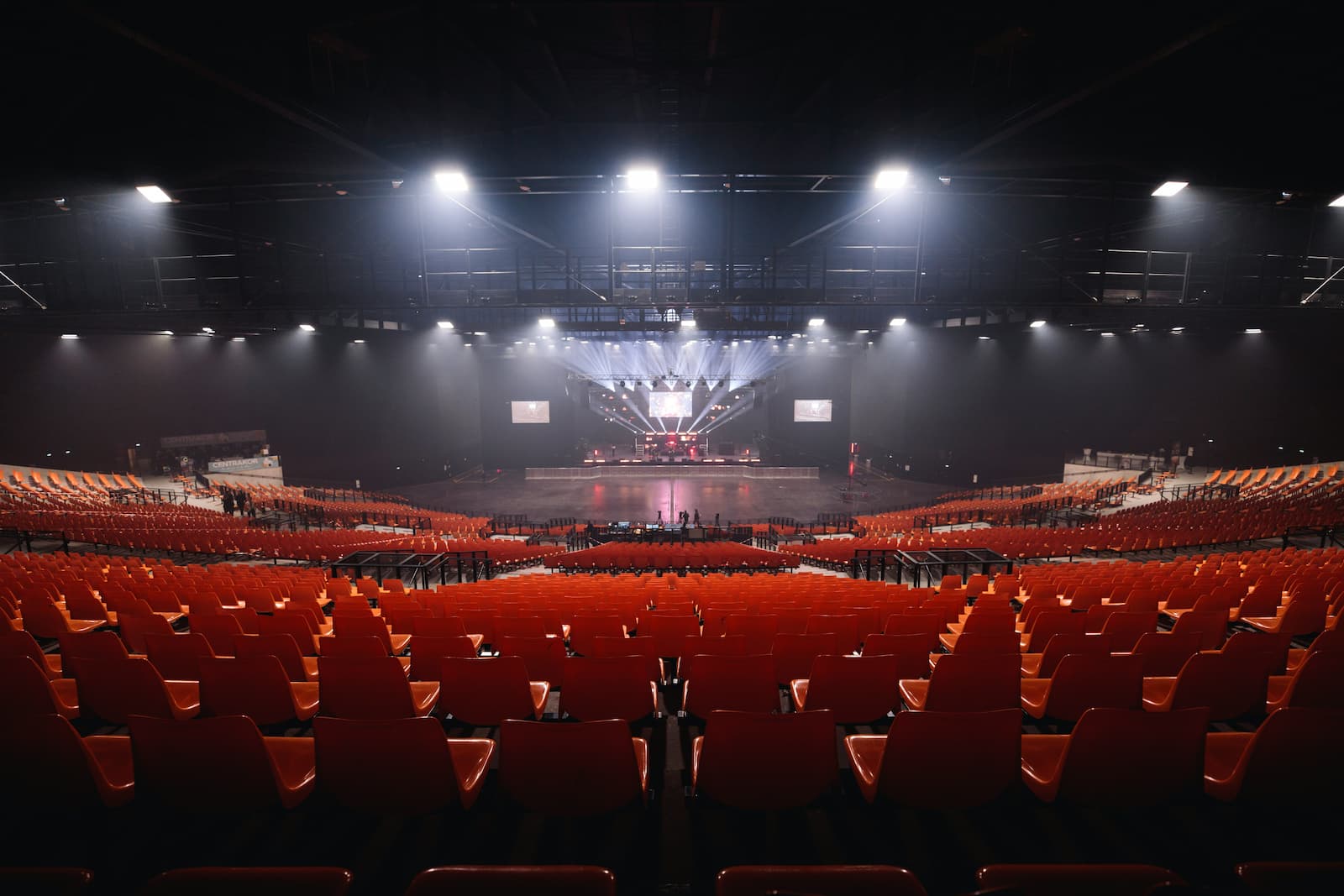
In July 2026, Canadian prog-rock band Rush played four nights at the United Center in Chicago. Six weeks earlier, four nights at the Kia Forum in Los Angeles. Next February the band plays Helsinki once, and then the tour is over.
Same band, same production, same year. One market gets four nights. Another gets one.
The published schedule for the Fifty Something Tour runs 88 shows across 48 cities between June 2026 and April 2027. Read one city at a time, it looks like a routing decision. Read as a whole, it is a chain of residencies of decreasing depth, where the number of nights tracks how much a market can absorb and how expensive it is to leave it.
Touring economics are usually discussed one show at a time. How many tickets, at what price, against what costs. The more useful question sits one level above that, and it is the question a promoter actually has to answer: how many nights does this city get, and what does it cost to move to the next one.
Why do artists play several nights in the same city instead of visiting more cities?
Because moving is the expensive part. Staying in one building avoids a full teardown, a long haul and a second setup. On Rush’s 2026 tour the deepest markets get four nights while most of Europe gets one, and three forces explain the difference: demand depth, distance between cities, and the artist’s own recovery time.
It all comes down to one number: how many nights a given city can carry.
A tour that behaves like a chain of residencies
Grouped by number of nights, the schedule stops looking like a route and starts looking like a ladder.
| Nights | Markets | Region |
|---|---|---|
| 4 | Los Angeles, Fort Worth, Chicago, New York, Toronto | North America |
| 3 | London | Europe |
| 2 | 23 markets, including Boston, Detroit, Montreal, Seattle, Denver, Atlanta, Glasgow, Manchester, Santiago and Sao Paulo | Mostly North America |
| 1 | 19 markets, including Paris, Berlin, Amsterdam, Munich, Milan, Copenhagen, Oslo, Stockholm, Helsinki, Rio and Brasilia | Mostly Europe and South America |
The five four-night markets share a profile: deep and long-standing fan bases, arenas between 14,000 and 23,500 seats, and, with the exception of Toronto, a very long drive to whatever comes next.
That ladder is the same logic examined in concert residency economics, applied here across an entire touring cycle rather than a single venue.
The night that never comes twice in a row
Look at the dates rather than the cities and a rule appears that nobody announces.
Los Angeles: June 7, 9, 11 and 13. Chicago: July 16, 18, 20 and 22. New York: July 28, 30, August 1 and 3. Toronto: August 7, 9, 11 and 13.
Across 88 shows and 48 cities, Rush does not play two nights in a row. Not once, in ten months.
More telling still, the rhythm holds when the band changes country. Paris on February 19, Berlin on the 21st, Amsterdam on the 23rd, Munich on the 25th. One show, one day off, one show, in four different countries. The pattern comes from the performer, not from the buildings or the logistics.
Two ways to occupy a venue
Rush in Chicago: 4 shows across 7 days (July 2026)
show
dark
show
dark
show
dark
show
Taylor Swift in Miami: 3 shows across 3 days (October 2024)
show
show
show
Rush needs nearly two days per show. Swift needed one, in a stadium, with an even larger production. Three dark days of venue occupancy against none.
Nobody will ever put this in a press release, and there is no reason to. Read from the calendar, it is plain enough. A band that has been on the road for five decades needs a day between performances, and the schedule is built around that fact rather than against it.
Which leads to the point that reframes the whole thing. The rest day is going to happen either way. It is not a variable. The only decision available is what to do with it.
Tour routing: what it costs to move
Two options exist for that unavoidable day off.
The band can travel. In North America that means an average of roughly 900 miles (about 1,400 kilometers) between the markets on this tour, with the full production on trucks, a teardown the night before, a setup on arrival, and a fresh venue rental at the other end.
Or the band can stay. Same building, same rig, same hotel, and a dark day inside a venue where everything is already hanging.
Major arena rental now runs between $50,000 and $150,000 per night. Madison Square Garden reportedly cost $400,000 in 2006, close to half a million in today’s money. Against that, promoter margins can fall as low as 1 percent of gross, with the artist taking up to 30 percent. There is very little room for a wasted day.
What no venue publishes is the number that decides the whole calculation: what a promoter pays for the night in between. That figure lives in the settlement, and settlements are private. What can be said is that the building cannot sell that day to anyone else, because the stage is on the floor and the rig is in the roof, while the venue still carries staff, security and power.
So the trade is straightforward. Staying put means paying for dark days. Moving means paying for haulage, a second teardown, a second setup and a second full rental. For an artist who cannot perform on consecutive nights, a multi-night run is not a luxury format. It is the cheapest available way to spend a day off.
The revenue side of the same equation is covered in revenue per attendee, and applied to this specific band in the Rush case study.
When the plan breaks: what Fort Worth cost
Fort Worth was scheduled exactly like Chicago: four nights at Dickies Arena on June 24, 26, 28 and 30. Then two separate things went wrong, three weeks apart, and the run ended up spread across eighteen days.
First, logistics. In the band’s own words, “unforeseen travel and border-related delays impacting our touring production following our recent Mexico City tour dates” pushed the June 24 show to July 2. A border crossing with a full arena production behind it cost a show date. That is the physical cost of moving, made visible.
Then, health. Geddy Lee was diagnosed with laryngitis and bronchitis, and his doctors advised additional rest. The June 30 and July 2 shows moved again, to July 11 and July 13. The statement is worth quoting because it explains the logic of this tour better than any analysis can:
“After more than 50 years of touring, we’ve always believed that if we’re going to step on stage, we owe you the very best performance we can give, and right now, that simply isn’t possible.”
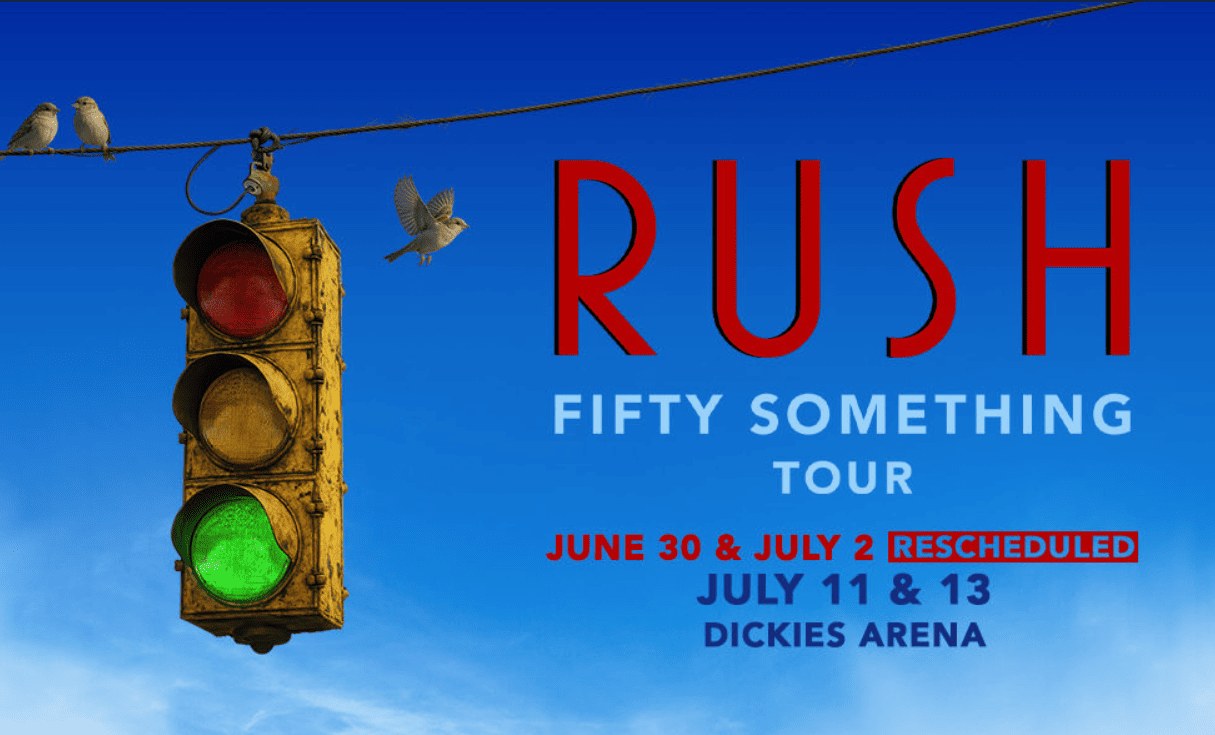
Rush, Fifty Something Tour (2026). Fort Worth rescheduling notice. Tour artwork © respective owners, used for editorial analysis.
Illness is not a function of age. Laryngitis reaches a singer of twenty-five as easily as one of seventy-three. What does change with a fifty-year career and 88 dates on the books is the calculation around it. Pushing through a bad throat is an option when the tour ends next week. It is not an option when the tour ends in April.
Two details are worth pulling out. The first is economic: the band could have cancelled and refunded. Instead it returned to Fort Worth on July 11 and 13, three days before opening in Chicago, which means either idle production or a trip back. Both cost money, and both were absorbed rather than passed to an audience that had already booked travel.
The second confirms everything above. Across two emergency reschedules, made under pressure and with a broken calendar, no two shows were ever placed on consecutive days. June 30 moved to July 11 and July 2 moved to July 13, two days apart, exactly as before. When there was every commercial reason to compress, nothing was compressed.
Europe plays by different rules
Cross the Atlantic and the format collapses to a single night almost everywhere. Paris, Berlin, Amsterdam, Munich, Cologne, Hamburg, Stuttgart, Milan, Copenhagen, Oslo, Stockholm, Helsinki. One show each. Glasgow and Manchester get two. London gets three, and is the only European market treated the way American markets are treated.
Demand depth is the obvious explanation, and it is a real one. But it is not the only one.
| North America | Europe | |
|---|---|---|
| Average hop between stops | ~900 miles | ~435 miles |
| Typical nights per city | 2 to 4 | 1, exceptionally 2 or 3 |
| Venue ownership | Concentrated: sports franchises, listed operators, private owners | Fragmented by country and city |
| Ticketing | Dominated by one operator, now under a court ruling and a fee cap | Multiple operators, market by market |
| Incentive to stack nights | High | Low |
Halve the distance and you halve the penalty for moving. A European run of single nights every two days is cheap precisely because the next city is close. The same routing across North America would put a tour bus and a fleet of trucks on the road for two days between shows.
So two independent forces point the same way. Deeper markets and longer distances make North America favor stacking. Shallower markets and shorter distances make Europe favor moving. London, with the demand profile of an American market, behaves like one.
Who owns the room
There is a common assumption that a large American tour negotiates with a single counterparty. The five arenas hosting the four-night runs say otherwise.
| Venue | Owner | Type of owner | Concert capacity |
|---|---|---|---|
| United Center, Chicago | Bulls and Blackhawks, 50/50 | Sports franchises | 23,500 |
| Madison Square Garden, New York | MSG Entertainment | Listed company | 22,000 |
| Scotiabank Arena, Toronto | Maple Leaf Sports & Entertainment | Sports group | 19,800 |
| Kia Forum, Los Angeles | Steve Ballmer | Private owner | ~17,500 |
| Dickies Arena, Fort Worth | City of Fort Worth | Municipal | 14,000 |
Five buildings, five different kinds of owner, five different sets of objectives. A city-owned arena answers to a council. A listed operator answers to a quarterly report. Two sports franchises sharing a building answer to their own calendars first. None of them is Live Nation.
Which is where the distinction matters. In April 2026 a jury found Live Nation and Ticketmaster liable on all counts, including monopolization of primary ticketing and unlawful bundling of promotion with venue services, with damages set at $1.72 per ticket and a potential total near $450 million after trebling. A month earlier the Department of Justice had settled separately for $280 million, requiring the divestiture of thirteen exclusive booking agreements at amphitheaters, opening up to 50 percent of ticket allocation to outside promoters, and capping ticketing service fees at 15 percent.
The divestitures cover amphitheaters, not arenas. On an arena tour the integration does not arrive through the deed to the building. It arrives through the ticket. Dickies Arena is owned by a Texan city and has nothing to do with Live Nation, yet the band’s own rescheduling notice directs ticket holders to request refunds through Ticketmaster.
That is the layer where a 15 percent cap changes a P&L. Who captures the booking fee, and in what proportion, is not an accounting footnote. On a four-night run at 20,000 seats it is a seven-figure line.
Why arenas and not stadiums
Roughly 80,000 people wanted to see Rush in Chicago. That demand can be served two ways: four nights of 20,000 in an indoor arena, or one night in a 60,000-seat stadium with room to spare.
The second option looks more efficient on paper and carries far more risk in practice. A stadium is a single, all-or-nothing sale. A four-night run sells in slices, with pricing and marketing adjustable between shows, and with the third and fourth nights added only if the first two justify them. Risk gets divided instead of concentrated.
There is a revenue argument too. An indoor arena monetizes better per head. Concessions are controlled, merchandise sells in a climate-controlled concourse rather than a wet field, sightlines are consistent, and the audience for a band of this vintage expects a seat, a roof and air conditioning. Every layer beyond the ticket performs better indoors, which is precisely where the per-attendee model does its work.
Choosing the smaller room is not a lack of ambition. It is a decision to take a known margin four times rather than gamble on a bigger one once.
Put the model to work
A tour schedule is the output. The input is a set of numbers, and the format question is the one that moves the most money. That part you can test rather than guess.
Compare one big night against several mid-size nights, model recurring versus one-time attendees, and see how the economics shift.
Try the model →The far end of the curve
If the logic holds, there is an obvious next step. Stop moving altogether.
In July 2026, radio host Eddie Trunk and British newspaper The Sun both reported that Rush is in talks for a residency at Sphere in Las Vegas, in the region of 16 to 18 shows during 2027. No announcement has been made, no contracts are confirmed, and both reports trace back to the same unnamed sources, so this belongs in the speculation column. One detail gives it weight: Las Vegas does not appear anywhere on a tour that visits 48 cities.
Economically, a residency of that size is the ladder taken to its logical end. Zero haulage. One load in, one load out, spread across months instead of days. A single venue negotiation instead of forty-eight. And for a band that needs a day between shows, a schedule where the rest day costs nothing more than staying in the same hotel.
The same trade appears at every rung of the ladder. Four nights in Chicago is a small version of it. Eighteen nights in one building is the version where the travel line disappears from the budget entirely.
What the calendar actually encodes
A tour schedule reads like a list of dates. It is a series of decisions, each with a number behind it.
Six forces set the number of nights a market receives:
- how deep the demand runs
- how far the next city sits
- how much recovery the artist requires
- what a dark day costs inside a booked venue
- who owns the room and the ticket
- how much risk the promoter is willing to concentrate in a single sale.
Chicago gets four nights because all six point the same way. Helsinki gets one for the same reason, in reverse. Anyone routing a tour, booking a venue or building a run of shows is answering these questions whether or not they are written down.
Note on sources. Tour dates and quotations are taken from Rush’s official communications. Venue ownership and capacity figures are from public sources. Rental ranges and margin figures are industry estimates and are labeled as such. The Sphere residency is an unconfirmed report at the time of writing.
© 2026 Oriol Guitart. This article, Four Nights in Chicago, One in Helsinki: The Economics of Tour Routing, together with the Revenue Per Attendee Model© and the Live Event Residency Model©, has been developed by its author, Oriol Guitart. All rights reserved for the full term and scope established under Intellectual Property Law. Any total or partial reproduction, distribution, public communication and/or transformation is strictly prohibited without the author’s prior express written consent, and in any event the author must be acknowledged as such in any subsequent use.