Allowing Ourselves to Make Mistakes Post

Allowing Ourselves to Make Mistakes

Allowing ourselves to make mistakes is a necessary condition for learning. When disciplines are trivialized and intervention occurs without assuming responsibility, decisions are usurped and accountability is diluted. Without real autonomy—and without the right to err—there is no learning, no commitment, and no legitimacy to demand results.

The Inflation of Leaders and the Scarcity of Accountability

The Inflation of “Leaders” and the Scarcity of Accountability

In some organizations, leaders may be abundant, yet those truly responsible for understanding what is happening and why are scarce. Execution is outsourced, and with it, control and learning are lost. Keeping part of execution in-house should allow organizations to develop judgment, make well-founded strategic decisions, and ensure that action becomes the true test of leadership.

OKR vs KPI

OKRs vs. KPIs: What to Measure, When, and for What Purpose

Measuring is not about accumulating metrics; it is about making better decisions. In this post, I explain the real difference between KPIs and OKRs, why confusing them ends up burning out teams, and how to use them in a complementary way: KPIs to ensure the health of the business, and OKRs to drive growth and strategy without falling into analysis paralysis.

From Artisanal Business to Scalable Company

From “Artisanal Business” to Scalable Company

A master luthier creates exceptional instruments, has strong demand, and even a waiting list, yet his business is limited by his own time. Scaling up means taking risks: investing, hiring, and moving from being solely a craftsman to becoming a manager. The real initial barrier isn’t the market—it’s a mindset: the vertigo of growth and the challenge of building a professional structure that allows expansion without losing quality.

The 4 Vectors of

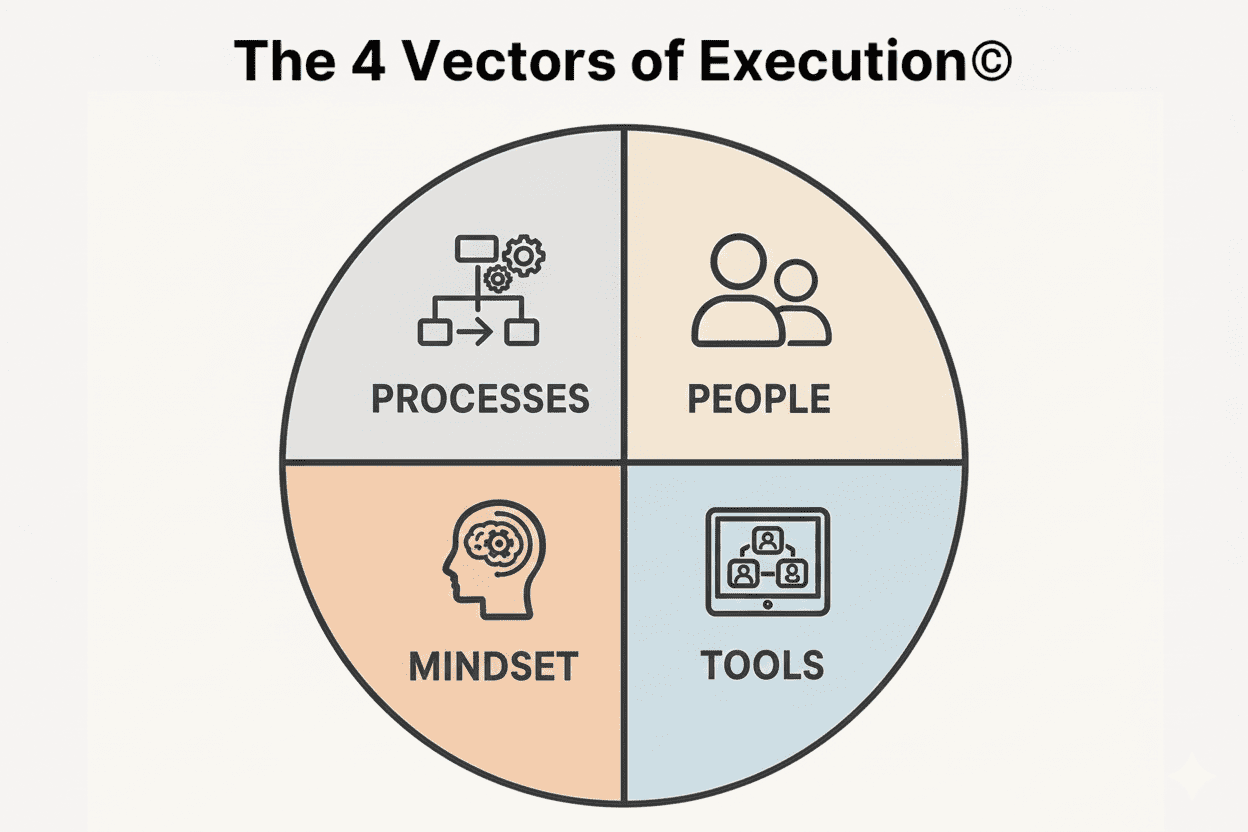
The 4 Vectors of Execution©

Moving from strategy to execution is not a problem of ideas or planning, but of alignment. Execution only works when four inseparable vectors come together: clear processes, capable people, sufficient tools and resources, and the right mindset. The absence of any one of them can block or sabotage even the best strategy. Execution is not about demanding more effort, but about creating organizational coherence.

Incompetencia

The Invisible Cost of Promoting the Incompetent

Promoting the wrong person is not just an HR mistake; it is a cultural signal that distorts decision-making, erodes performance, and drives talent away. Incompetence rises through politics and appearance, while teams pay the price in demotivation, loss of excellence, and a silent yet profound deterioration of the organization.

Seguir remando en un entorno profesional que no controlamos

Keep Rowing — Skills and a Roadmap for Professional Uncertainty

The professional journey is like a river: part of the route is known, but market currents and organizational flows shift without warning. We do not control the riverbed itself—only how we choose to navigate it and with which tools. Our skills are the oars that determine our ability to maneuver; strengthening them is essential to handle turbulence, avoid drifting, and keep a deliberate course.

De Product Centric a Customer Centric

From Product-Centric to Customer-Oriented

Adopting a customer-centric approach is not a quick project, no matter how much we try to accelerate, but rather a profound transformation of the organization’s DNA. It means moving from selling products to solving customer problems, breaking down silos, redefining KPIs, and rebuilding processes, culture, and technology. With all this, the greatest risk is to stop halfway — unable to complete the journey and left stranded in no man’s land.