The End of the “Free Ride”: Why ChatGPT is Introducing Advertising
As we move into 2026, the Artificial Intelligence ecosystem has reached a critical tipping point. After years of explosive growth and mostly free access, OpenAI has confirmed the move many analysts predicted: the arrival of advertising to ChatGPT.
This shift marks the end of an era of experimentation and the start of a phase of financial realism. But why does a company generating billions of dollars need to include ads in our conversations?
The 2026 Paradox: Disruptive Solutions with 2005 Revenue Models
We are living in a fascinating and somewhat contradictory situation.
“We are facing absolutely disruptive solutions typical of 2026, capable of reasoning and executing complex tasks, yet they are forced to apply revenue models from 2005.”
Advertising is the “old parameter” that continues to govern the “new world.” Although AI is a cutting-edge technology, its economic sustainability still relies on traditional mechanisms.
This explains why, to maintain massive access without skyrocketing subscription fees, companies must turn to a model we know well from the search engine era. The future is breathtaking, but the bills are still being paid using the methods of the past.
Sponsored Recommendations: What Will Advertising in the Chat Look Like?
Don’t expect any major disruption here. Often, reinventing the wheel isn’t necessary, nor does it bring incremental benefits that justify the costs incurred.
OpenAI says it has designed a system intended to be as unobtrusive as possible, moving away from traditional banners. Ads would appear in the form of “Sponsored Recommendations”, placed just below the chat responses. These ads will be contextual, meaning they are based on the topic of your current conversation to offer relevant products or services.
To safeguard the service’s ethics, the company states it will establish “red lines”: advertising related to health, politics, or content aimed at minors will be excluded. OpenAI also assures that these ads will not influence the objectivity of the AI’s responses; they will simply appear as additional suggestions once the model has finished its output.
We’ve seen all of this before (Google Ads), but this isn’t about impressing users—for that, generative AI already does the job—it’s about monetizing as quickly as possible.
The Cost of Intelligence: How Much Does It Cost to Run ChatGPT?
AI isn’t just software; above all, it is a massive and extremely expensive physical infrastructure. OpenAI has projected expenses that force an acceleration in monetization. To understand this decision, we must look at the company’s core expenditures:
- Compute and Servers: Maintaining models in real-time requires massive computing power. Estimates suggest server costs exceed $13 billion annually —a figure that becomes clear when analyzing the Microsoft and OpenAI $100 billion supercomputer infrastructure, specifically designed to meet the demands of next-generation AI
- Model Training: Developing new versions (such as the long-awaited GPT-5 or advanced reasoning models) requires one-time investments of $3 billion to $5 billion per major iteration.
- Human Talent: The war for specialized AI engineers has sent salaries soaring, with personnel costs exceeding $1.5 billion.
Despite OpenAI achieving a projected revenue of $20 billion, profit margins remain thin due to these staggering operating costs. Advertising appears as the necessary engine to scale without burning through all available cash.
A quick and accessible resource, albeit with a vintage flavor that is hard to ignore.
Current Snapshot: ChatGPT Users and Revenue Streams
To put this decision into perspective, it’s helpful to observe the volume of users compared to those who actually pay for the service.
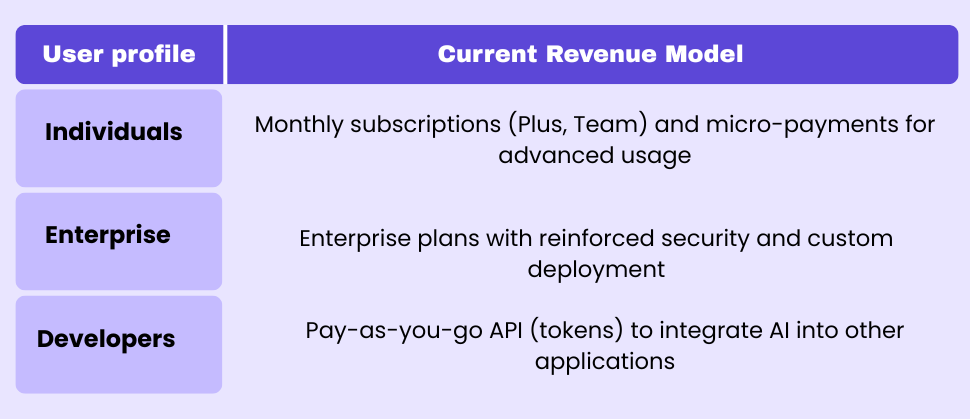
At the beginning of 2026, based on 2025 financial reports (where OpenAI surpassed $20 billion in annualized revenue), the approximate breakdown is as follows:
1. Individual Users (Consumers)
Share: ~70%–75% of revenue. This is by far the largest source of income. This group includes:
- ChatGPT Plus ($20/month): The core base with millions of subscribers.
- ChatGPT Pro ($200/month): A subscription aimed at power users with access to advanced reasoning models (such as the o1 series).
- ChatGPT Go: Lower-cost versions offered in specific markets (such as India).
2. Business / Enterprise Sector
Share: ~15%–20% of revenue. This is the fastest-growing segment. It includes:
- ChatGPT Team: Designed for small and medium-sized businesses ($25–$30 per user).
- ChatGPT Enterprise: Custom contracts for large corporations (such as Fortune 500 companies) with enhanced security and expanded capabilities.
3. Developers
Share: ~10%–15% of revenue. Although this segment is the “engine” powering thousands of external apps, its percentage share of total revenue has declined relative to direct ChatGPT subscriptions.
- Usage-based model: Developers pay per processed “token” (the unit used to measure how much text the model processes).
- Growth: While the percentage share is smaller, absolute volume continues to rise thanks to widespread use of models like GPT-4o and newer reasoning models in third-party applications.
Regarding the current user mix:
- Active Users: ChatGPT is estimated to exceed 800 million monthly users.
- Paying Users: Of that critical mass, only about 15-20 million hold premium subscriptions.
This massive gap between users who consume resources (free) and those who generate direct income (paid) is what makes advertising the necessary bridge to profitability.
“The model is only sustainable if someone absorbs the cost: either through subscriptions or through advertising. It’s a vintage one, but one that becomes rapidly deployable once a sufficiently large user base is reached.”
The question is: what will the others do? The cost structure (DeepSeek aside, despite its unknowns) is similar, so absorbing users who might hypothetically leave ChatGPT in response to advertising would increase the operating costs of Gemini, Claude, or any other competitor.
A Necessary Balance for the Future
The introduction of ads is the toll to keep AI a democratic good (in terms of access) rather than a tool exclusive to those who can afford a monthly subscription.
We shouldn’t consider this the “maturity” of the industry; rather, it is an urgent, reactive strategy in response to a situation that has little to do with technology and everything to do with the need to monetize.
The “everything for free” approach helped the world adopt the technology, but AI now needs to prove it can be a self-sustaining business under the economic realities of the market.